MSU doctoral research on 160 million-year-old salamander species' health earns national award
Author: Jessa-Lynn Adkins
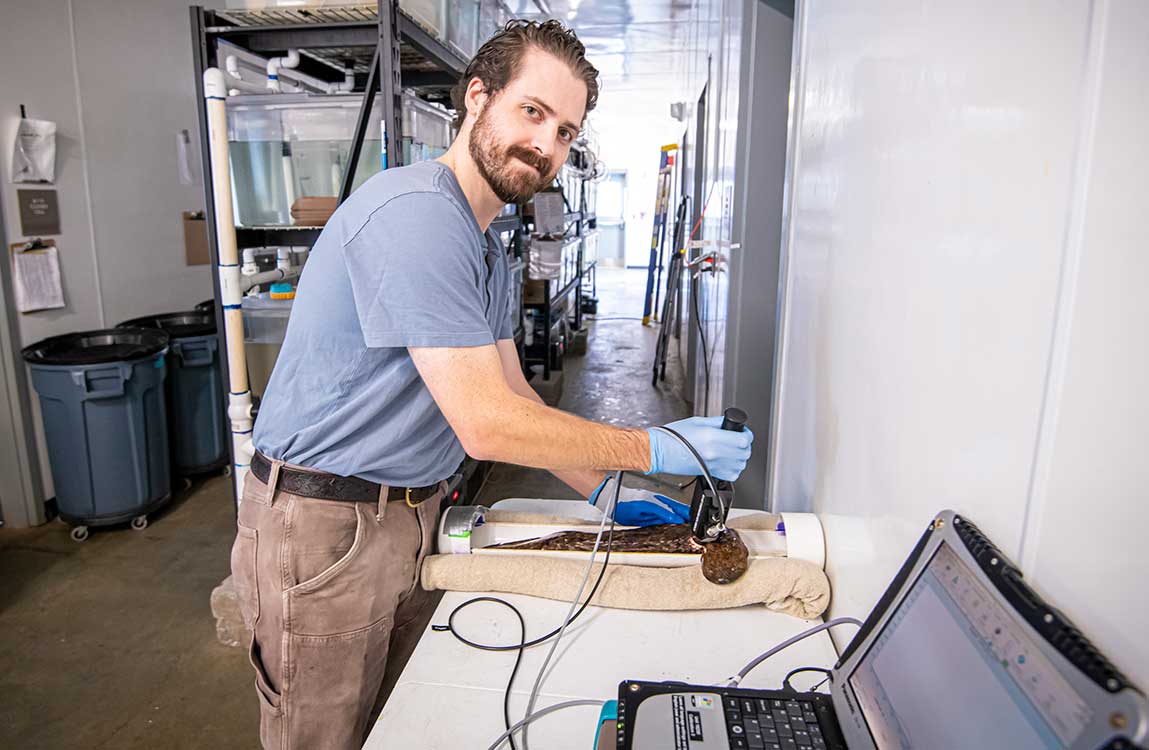
Mississippi State doctoral student Sam Mathes uses near-infrared spectroscopy to screen the health of an Eastern hellbender. (Photo by David Ammon)
A Mississippi State doctoral student has earned national recognition for research using near-infrared spectroscopy to screen the health of Eastern hellbenders, a 160-million-year-old amphibian species of conservation concern.
Sam Mathes, also a research associate in the Department of Biochemistry, Nutrition and Health Promotion, received the inaugural Green-Wave Award for Conservation Innovation as part of the SpectraWizard's Spectroscopy Application Challenge, sponsored by StellarNet, Inc.
"Researchers worldwide submit innovative uses of this technology, so this recognition is a tremendous honor," Mathes said.
Using near-infrared spectroscopy, or NIR, Mathes evaluates Eastern hellbenders' health through non-invasive technologies. The research technique uses light to build a biochemical health profile through an animal's skin or secretions.
"Our job is to assess these animals' health in a minimally invasive manner and provide information that helps wildlife managers support their survival and population growth," Mathes said.
Eastern hellbenders, often called "snot otters" due to the mucus secreted through their wrinkled skin, are fully aquatic salamanders that serve as an indicator of freshwater ecosystem health. Having existed for roughly 160 million years, the ancient species also coexisted alongside dinosaurs.
"I loved dinosaurs as a kid, so naturally I became enamored with the prehistoric-looking species. They are fascinating and there is still so much to learn about them," Mathes said. "I had no experience with spectroscopy before coming to MSU, but I've grown to love it. It has given me the opportunity to work in animal conservation while expanding my knowledge of animal systems."
A native of Columbus, Ohio, Mathes earned a bachelor's degree in music production and a master's degree in ecology and evolutionary biology from Ohio University. He is now in his third year of MSU's interdisciplinary animal physiology program, housed within the Department of Biochemistry, Nutrition and Health Promotion and the Department of Wildlife, Fisheries and Aquaculture.
Mathes conducts his research in MSU's Conservation Physiology Laboratory with funding support in part from the national Institute of Museum and Library Services and U.S. Department of Agriculture.
"I'm grateful to be recognized for this research and especially thankful to Dr. Jelena Muncan, an MSU postdoctoral associate, whose support led me to this opportunity," Mathes said.
The animal physiology graduate degree program is an interdisciplinary program in the College of Agriculture and Life Sciences' Department of Biochemistry, Nutrition, and Health Promotion, and the College of Forest Resources' Department of Wildlife, Fisheries and Aquaculture.
Date: 2026-10-10