CALS Influence Stories
They’ll be the judge of that!
New livestock judging facility prepares tomorrow’s ag leaders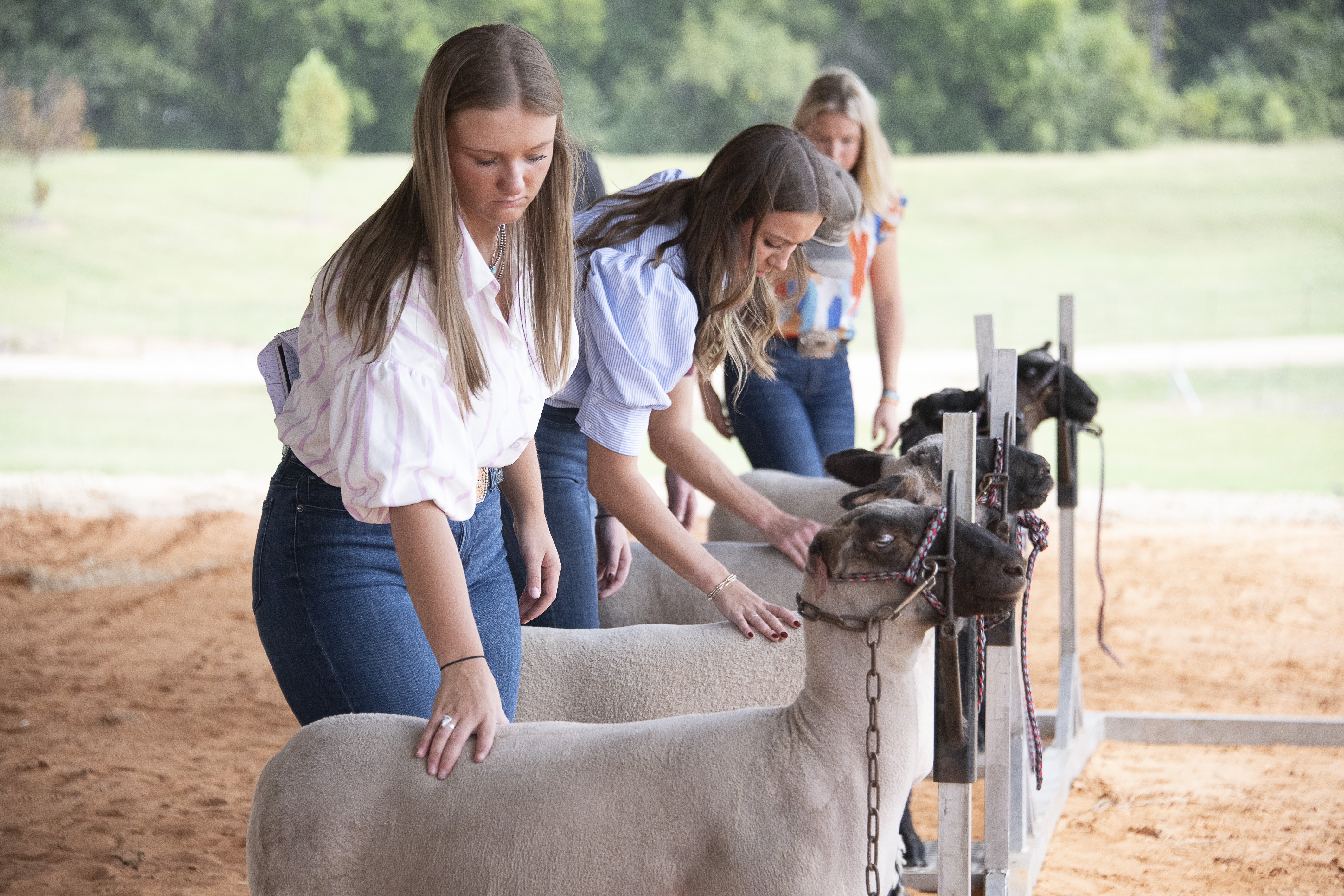
Ask most of any Mississippi State students about their favorite place on campus and it might be Dudy Noble, Davis Wade, the Mitchell Memorial Library, or even the Perry Cafeteria. For a unique group of students, however, their favorite place on campus is the newly constructed Livestock Evaluation Laboratory on the MAFES H. H. Leveck Animal Science Research Center, also known as South Farm.
Since its establishment in the 1920s, MSU’s Livestock Judging Team has given students the opportunity to perfect their craft and learn more about the importance of livestock production. Being prepared for competitions takes both knowledge and skill. A typical contest requires each member of a five-person team to judge twelve classes of livestock which can include breeding and market cattle, sheep, hogs, and goats. These classes consist of four specimens to be ranked first through fourth based on form (musculature, bone structure, and overall appearance) and function (the animal’s intended use). At the conclusion of this portion, the competitors will be required to present eight sets of oral reasons that explain their rankings.
The team spends every Tuesday evening, Friday evening, and Saturday together, training. Prior to this season, team members met in various classrooms in the Animal and Dairy Science building. With many other student groups vying for those same spaces, having a separate place for the team was an identified need. Now, they have their own state-of-the-art facility to call home, complete with a workroom, lounge, office, and conference room. A multipurpose, open-air arena is used to set up live practice rounds. This centralized location allows for more efficient and productive practice sessions. Whether watching film or sharing a meal, this dedicated space helps better prepare the team for competition, while fostering a close-knit community.
The organization is primarily funded through donations and fundraisers like summer clinics, hosted by team members. The construction of the facility could not have been possible without support from U.S. Senator Cindy Hyde-Smith and alumni Rodney Moore and Brian Atkins. Moore, who established the Rodney Moore and Family Livestock Judging Facility Support Fund, has been an avid supporter of the new facility.
To compete at a level that is consistent with competitors and worthy of this new space, team members must have extraordinary focus and discipline. It can be especially hard to exhibit these traits on home football gamedays when the cowbells of excited fans can be heard ringing in the distance while attending an hours long practice. Excellence and dedication are also expected outside of the arena. This year, every member of the team maintained a GPA at or above 3.00. Taking initiative and finding personal drive are the keys to balancing a busy schedule and demanding schoolwork.
Libby Welch, a junior animal and dairy sciences major from Jonesboro, Arkansas, noted the importance of communication and understanding.
“At the beginning of each semester, we are required to reach out to our professors introducing ourselves and outlining the dates we expect we will be absent,” she said. “For many of our professors, this is the first time they have heard about us. It is rewarding to introduce others to our passion and impact.”
Helping this team of students balance academics and reach their goals takes a leader who has been in their shoes. Alex Pittman, an former instructor in the Department of Animal and Dairy Sciences and former coach of the MSU Livestock Judging Team, knows firsthand what it takes to balance livestock judging and academic responsibilities. While her path diverged from an initial plan to attend vet school, the impact she is making on the future of animal production is significant.
“I was a livestock exhibitor from the age of five. I was a sophomore in college when I found my interest in judging, encouraged by the team’s assistant coach to join the team,” Pittman said. “Since then, I have made my career investing in students like myself and instilling in them a new passion.”
For Riley Smallen, a senior agricultural education, leadership, and communications major from Tellico Plains, Tennessee, Pittman played a vital role in her recruitment to Mississippi State University.
“I admired Coach Pittman long before I came to campus,” she said. “Her passion for her job, the way she invests in her team, and her reputation of high standards are all qualities that make her a leader I want to emulate. So aside from obtaining my degree, this team is why I chose MSU.”
The team has more to offer students than understanding animal production and welcomes students from any major.
Tucker Woods, a senior majoring in golf and sports turf management from Seminary, Mississippi, transferred from Jones County Community College where he had been a member of the collegiate show team. When he felt like something was missing from his senior college experience, he found the livestock judging team. He shared some of the transferable skills he has obtained through his participation.
“I have learned what it means to be a leader. I have learned to stand firm in my convictions, but also the importance of listening and respecting the views of others,” he said. “Regardless of the career I enter, I will be expected to work with members or clients, and I have gained communication skills that will help me relate to anyone.”
Another Mississippi native, Aleigha Eubanks from Lucedale, is a junior majoring in animal and dairy sciences with a production management concentration. She shared how the skills she has gained from the experience will help her as she plans to enter a career that will benefit the economy of her home state after graduation.
“One day I see myself working with cattle here in Mississippi,” she said. “Not only am I being exposed to industry professionals, but I am gaining the confidence to assert myself in these spaces.”
The Mississippi State University Livestock Judging Team provides a transformative experience rooted in discipline, leadership, and community. The newly constructed facility stands as a testament to the team’s growth and the university’s commitment to agricultural excellence. With the guidance of dedicated mentors and the support of alumni, faculty, and donors, this program continues to help shape the next generation of agricultural leaders.
By: Carson McFatridge